http://www.youtube.com/watch?v=AjnFGk4GTd0
My favorite living pianist playing the most beautiful nine minutes of the 20th Century.
Sunday, February 11, 2007


Friday, February 09, 2007
Sub-prime mortgage really are more risky
The Wall Street Journal in the past few days has featured stories about the troubled subprime mortgage industry. There was a particularly telling graph today:

One thing about the graph that leaps out is that under all market conditions, subprime mortgages really are not just riskier and more costly, but substantially riskier and more costly than prime and Alt-A mortgages. While late payments do not necessarily lead to default (most of the time they do not), mortgages with late payment require more servicing, or individual attention, from lenders, and are therefore more expensive.
With the housing market slowing, it is also now more likely that late-payment mortgages will eventually go into default; this is the reason HSBC has had to set aside $10.5 billion reserves for potential sub-prime mortgage losses. To place this in context, HSBC earnings are about $15 billion per year.
Advocates worry that subprime borrowers pay too much for mortgages. While there are doubtless borrowers in the subprime pool who qualify for prime mortgages, and who should be encouraged to use the prime market, as a group, subprime borrowers are riskier. The data from the past few days suggest that it is possible that the mistake some lenders made was not charging too much, but rather not charging enough.
The data also suggest that for many borrowers, the absence of a subprime market would produce an absence of opporuntity for any mortgage.
Monday, January 29, 2007
Great Lyrics Period
| Goethe, Erlkönig Original German | English Translation |
|---|---|
| Wer reitet so spät durch Nacht und Wind? | Who rides, so late, through night and wind? |
Great Lyrics for Urban Economists
From Talking Heads
Cities
-------
Think of London, a small city
It's dark, dark in the daytime
The people sleep, sleep in the daytime
If they want to, if they want to
CHORUS
I'm checking them out
I'm checking them out
I got it figured out
I got it figured out
There's good points and bad points
Find a city
Find myself a city to live in.
There are a lot of rich people in Birmingham
A lot of ghosts in a lot of houses
Look over there!...A dry ice factory
A good place to get some thinking done
Down el Paso way things get pretty spread out
People got no idea where in the world they are
They go up north and come back south
Still got no idea where in the world they are.
Did I forget to mention, to mention Memphis
Home of Elvis and the ancient greeks
Do I smell? I smell home cooking
It's only the river, it's only the river.
Cities
-------
Think of London, a small city
It's dark, dark in the daytime
The people sleep, sleep in the daytime
If they want to, if they want to
CHORUS
I'm checking them out
I'm checking them out
I got it figured out
I got it figured out
There's good points and bad points
Find a city
Find myself a city to live in.
There are a lot of rich people in Birmingham
A lot of ghosts in a lot of houses
Look over there!...A dry ice factory
A good place to get some thinking done
Down el Paso way things get pretty spread out
People got no idea where in the world they are
They go up north and come back south
Still got no idea where in the world they are.
Did I forget to mention, to mention Memphis
Home of Elvis and the ancient greeks
Do I smell? I smell home cooking
It's only the river, it's only the river.
Thursday, January 25, 2007
Brad Delong cites AngryBear on Tyler Cowan
http://delong.typepad.com/sdj/2007/01/steven_kyle_thi.html
The issue of income distribution is problematic. We like to think that income is a function of virtue (i.e., hard work, honest dealings, etc.), but the reality is that it is also a function of endowments at time of birth. The most conventional of these endowments is parental wealth, but the most important (at least within the contect of the United States) is the initial store of human capital--that is, talent.
The initial distribution of talent is anything but "fair." Doctors make a good income in part because they work very hard to become Doctors, but if they also tend to be people who were lucky enough to be born pretty smart.
Remarkably, people seem to be more or less OK with the outcomes that the distribution of talent produces--there doesn't seem to be that much resentment of the incomes of Tiger Woods or orthopedic surgeons. But problems do arise and there is resentment when those who work 40 hours a week cannot grasp certain basics--an affordable house, a decent neighborhood, a decent school for their kids, a reasonable commute. It used to be that people without the intellectual acument to go to college could have these things, but they often no longer do.
These are not unreasonable things for working Americans to want, and there is only one way to make sure they have them--some form of income redistribution. There seem to be two acceptable ways to do this politically. The first is to increase the minimum wage. While conventional economic theory predicts that this will lower employment, the most likely outcome of an increase in the minimum wage is that businesses (all of which are subject to the wage floor) will raise their prices to consumers--implicitly tax all of us who consume. Personally, I am fine with that.
The other method for raising living standards for working Americans at the bottom of the income distribution is to get a larger Earned Income Tax Credit. To do this without increasing the fiscal deficit means some of us will have to pay higher taxes. I am fine with that too. My first choice: increase the tax on gasoline. We'll talk more about that soon.
The issue of income distribution is problematic. We like to think that income is a function of virtue (i.e., hard work, honest dealings, etc.), but the reality is that it is also a function of endowments at time of birth. The most conventional of these endowments is parental wealth, but the most important (at least within the contect of the United States) is the initial store of human capital--that is, talent.
The initial distribution of talent is anything but "fair." Doctors make a good income in part because they work very hard to become Doctors, but if they also tend to be people who were lucky enough to be born pretty smart.
Remarkably, people seem to be more or less OK with the outcomes that the distribution of talent produces--there doesn't seem to be that much resentment of the incomes of Tiger Woods or orthopedic surgeons. But problems do arise and there is resentment when those who work 40 hours a week cannot grasp certain basics--an affordable house, a decent neighborhood, a decent school for their kids, a reasonable commute. It used to be that people without the intellectual acument to go to college could have these things, but they often no longer do.
These are not unreasonable things for working Americans to want, and there is only one way to make sure they have them--some form of income redistribution. There seem to be two acceptable ways to do this politically. The first is to increase the minimum wage. While conventional economic theory predicts that this will lower employment, the most likely outcome of an increase in the minimum wage is that businesses (all of which are subject to the wage floor) will raise their prices to consumers--implicitly tax all of us who consume. Personally, I am fine with that.
The other method for raising living standards for working Americans at the bottom of the income distribution is to get a larger Earned Income Tax Credit. To do this without increasing the fiscal deficit means some of us will have to pay higher taxes. I am fine with that too. My first choice: increase the tax on gasoline. We'll talk more about that soon.
Tuesday, January 09, 2007
New Orleans (again)
In 1960, New Orleans had 627,000 people and was the largest and perhaps still most important city in the South. It now is smaller than Lexington, Kentucky. Most of the reason for this is, of course, Katrina, but much of the reason is not. New Orleans had already lost around 20 percent of its peak population before Katrina, and as such was very much like unglamorous cities such as Milwaukee, Cincinnati, and Baltimore. So while it didn't lose as much as Buffalo, Pittsburgh, St. Louis and Cleveland, it was hardly putting in an all-star performance, even before Katrina hit.
A question I want to focus on over the next year is why New Orleans--a city I rather love--has evolved (devolved?) as it has. Race certainly has a lot to do with it, but cannot by itself explain the city's fade. Atlanta is a heavily black, southern city that has performed far better--if less charmingly--than its neighbor to the southwest.
Of the course if this year, I will be president of a small association of academics who do what I do--the American Real Estate and Urban Economics Association. I will be giving my presidential address next January in New Orleans. I therefore think that the focus of the address should be about New Orleans. I have a lot of reading to do between now and then; I welcome suggests for reading, people to talk to, and just opinions from well-informed people about the city's history and its future. You may read my preliminary views in the archives.
Thanks for any suggestions or help.
A question I want to focus on over the next year is why New Orleans--a city I rather love--has evolved (devolved?) as it has. Race certainly has a lot to do with it, but cannot by itself explain the city's fade. Atlanta is a heavily black, southern city that has performed far better--if less charmingly--than its neighbor to the southwest.
Of the course if this year, I will be president of a small association of academics who do what I do--the American Real Estate and Urban Economics Association. I will be giving my presidential address next January in New Orleans. I therefore think that the focus of the address should be about New Orleans. I have a lot of reading to do between now and then; I welcome suggests for reading, people to talk to, and just opinions from well-informed people about the city's history and its future. You may read my preliminary views in the archives.
Thanks for any suggestions or help.
Wednesday, January 03, 2007
News from a tough real estate market: Metropolitan Detroit
Susan Carter, a Realtor from the Detroit area, writes:
While I think Susan overstates the power of the press, she is otherwise very much on target as to what is happening in her region. I also appreciate her remarks about exotic mortgage products.
I also think Susan demonstrates something that people don't think about very often when they think about Realtors--that the good ones know their markets exceptionally well, and that it takes a lot of diligence to know markets so well. The is the reason most people who go into the real estate business do not succeed--the median compensation for real estate agents is very low. As is the case in most businesses, long term success in the residential real estate market requires intelligence and hard work. I remember driving down a street in Madison some years ago with a well-known broker from that town, and he could tell me something about every single house on the street.
So how does one choose a good Realtor? When we are buying in Bethesda, we began by going to someone who was a leader in number of listings, a man named Gary Ditto. It turns out he was completely obsessed with the market. Susan seems pretty obsessed too. Go for the obsession.
As I thought about ways to best characterize the real estate market in Southeast Michigan in 2006 I looked at last year’s market report…and found I could almost repeat word for word the general market condition comments I made at the end of 2005. The characteristic optimism of Realtors has again been tested by the challenging economic issues facing Michigan AND continued consumer concerns about making major financial commitments. The supply of homes and condos for sale has been high all year and the number of motivated buyers low (especially in the over $250,000 price range)… a condition that can only be sustained for so long without discounted values…basic economics 101. 2006 saw a softening of prices in all areas and price ranges, in some cases up to 12-15 percent of 2004 values. Sellers who simply had to move in 2006 decided there was no point in waiting for a price recovery, especially as we saw the erosion of values tied to supply and demand as the market year progressed. People who wanted to trade up often could not sell their current house or condo, disrupting the typical home ownership cycle….first home, second home, then the keeper until retirement. The current soft real estate market is a complicated issue, one with many factors influencing the fundamentals of supply/demand/pricing, including…
1. Highly motivated sellers: relocation or long term owner sales. When employees are transferred or leave the area for new job opportunities some employers have guaranteed buy-out or sales support programs in place but most do not. At some point in a slow market people without relocation benefits just do not want to own or maintain homes here any longer….and they become the most motivated sellers in town. Owners undercut the market, reducing the list price to below the price of competing homes, to generate offers. When the property sells, the sales price is used to establish market value for future sales. Long time owners with a lot of home equity have started to do the same thing…undercut neighborhood pricing to sell instead of waiting for a market recovery. Buyers have access to sales data and make offers based on the lowest neighborhood price these days as opposed to overbidding in hot markets ten years ago.
2. I have said for the last 5 years that trendy, creative mortgage programs can be good tools when used in the right circumstances…the right buyer and the right home. Many of these programs are based on an assumption of appreciating real estate values, sustained employment and increasing incomes. Unfortunately most lenders do not explain the potential downside of interest only, balloon, adjustable, negative amortization or highly leveraged financing programs…and the impact of job loss or layoffs, which can make refinancing of adjustable or balloon mortgages impossible. Homeowners can be forced to sell if they cannot afford to refinance at current interest rates.
3. Michigan has the highest foreclosure rate per household in the country. Many people bought homes in the last few years counting on a continued robust, appreciating real estate market. Then the local market softened and people could not sell without bringing money they did not have to the closing table. Buyers just stopped making payments and waited for the inevitable. The number of foreclosed homes scares potential purchasers…they think that the bottom has fallen out of the real estate market and the only prudent thing to do is take a wait and see attitude while assessing the direction prices are heading.
4. The media often has banner headlines about the number of unsold homes without looking at the hard facts of real estate sales: there are a lot of reasons a home does not sell besides a weak local economy including a negative equity position that does not allow for price negotiation, changing buyer tastes in terms of style, location and lifestyle, a price that is way out market value range or the overall condition of the home. The power of the press in creating or killing consumer confidence has always amazed me.
While unemployment is high…almost 7 percent in Oakland County…I prefer to focus on the 93 percent of the people in the area who are working and could buy homes if they wanted or needed to. Housing corrections do not last forever and there are indications that consumers are feeling confident about local market conditions and are ready to move back into the housing market in 2007. Literally dozens of people have told me that they are tired of waiting; this will be the year to make a move. Once there is market activity I suspect that prices will rebound within 12-24 months. Our market is unique in that pricing still bears a relationship to actual construction costs. The number of sales tied to speculators is quite low here compared to other parts of the country. It seems to me that people are spooked by perceived loss of home equity…remember the dot.com stock market bust and the huge loss of paper wealth ….but they will not need a lot of encouragement to get back in the housing game if they need more space, want a different location or style of home. Home ownership can be a warm, fuzzy lifestyle benefit, hard to put a price tag on or quantify as strictly an investment.
While I think Susan overstates the power of the press, she is otherwise very much on target as to what is happening in her region. I also appreciate her remarks about exotic mortgage products.
I also think Susan demonstrates something that people don't think about very often when they think about Realtors--that the good ones know their markets exceptionally well, and that it takes a lot of diligence to know markets so well. The is the reason most people who go into the real estate business do not succeed--the median compensation for real estate agents is very low. As is the case in most businesses, long term success in the residential real estate market requires intelligence and hard work. I remember driving down a street in Madison some years ago with a well-known broker from that town, and he could tell me something about every single house on the street.
So how does one choose a good Realtor? When we are buying in Bethesda, we began by going to someone who was a leader in number of listings, a man named Gary Ditto. It turns out he was completely obsessed with the market. Susan seems pretty obsessed too. Go for the obsession.
Wednesday, December 20, 2006
Why Public Housing is Scorned
I came across this on You-tube:
http://www.youtube.com/watch?v=t29fgA5M7VA
This comes from the film Koyaanisqatsi (a Hopi word meaning life out of balance). From roughly minute 3 to minute 6 of this clip are shots of the notorious St. Louis public housing project Pruitt-Igoe, a subsidized housing project that was so awful, it was never more than 60 percent occupied. The eleven building complex of nearly 3000 units was torn down before it was 20 years old.
In a terrific essay ( http://www.soc.iastate.edu/sapp/PruittIgoe.html), Alexander Von Hoffman argues that even a well-designed Pruitt-Igoe would have been a failure, because St. Louis had been (and in fact continues to be) a dieing city. And so it has; the 4th largest city in the country in 1890 is now not among the top 50.
But Pruitt-Igoe was a representation of the modernist movement at its worst. The buildings were faceless and difficult to cool. Public spaces were neglected and shadowy, and bred crime. The shame is that the complex gave high-rise living for the poor a bad name. High rises can work well, so long as they are well maintained and managed (some of the most desirable places to live in Chicago, Vancouver, Hong Kong and, of course, New York are high rises). More important, the complex lent such a stigma to public housing that it eliminated it as a mechanism to house the poor.
Malpezzi and I have written that the public housing that the US has built has been invariably inefficient as a means for housing low-income people in expensive American cities. This doesn't necessarily mean that it must be so, but the disasters of Pruitt-Igoe and other large scale public housing projects (Cabrini-Green and Robert Taylor Homes in Chicago are almost as notorious) means we might never find differently.
http://www.youtube.com/watch?v=t29fgA5M7VA
This comes from the film Koyaanisqatsi (a Hopi word meaning life out of balance). From roughly minute 3 to minute 6 of this clip are shots of the notorious St. Louis public housing project Pruitt-Igoe, a subsidized housing project that was so awful, it was never more than 60 percent occupied. The eleven building complex of nearly 3000 units was torn down before it was 20 years old.
In a terrific essay ( http://www.soc.iastate.edu/sapp/PruittIgoe.html), Alexander Von Hoffman argues that even a well-designed Pruitt-Igoe would have been a failure, because St. Louis had been (and in fact continues to be) a dieing city. And so it has; the 4th largest city in the country in 1890 is now not among the top 50.
But Pruitt-Igoe was a representation of the modernist movement at its worst. The buildings were faceless and difficult to cool. Public spaces were neglected and shadowy, and bred crime. The shame is that the complex gave high-rise living for the poor a bad name. High rises can work well, so long as they are well maintained and managed (some of the most desirable places to live in Chicago, Vancouver, Hong Kong and, of course, New York are high rises). More important, the complex lent such a stigma to public housing that it eliminated it as a mechanism to house the poor.
Malpezzi and I have written that the public housing that the US has built has been invariably inefficient as a means for housing low-income people in expensive American cities. This doesn't necessarily mean that it must be so, but the disasters of Pruitt-Igoe and other large scale public housing projects (Cabrini-Green and Robert Taylor Homes in Chicago are almost as notorious) means we might never find differently.
Wednesday, December 13, 2006
Recruiting for MBAs in the Middle East

I am home from recruiting MBA students in Dubai and Cairo.
Cairo is one of the greatest cities I have ever visited; the architecture, street life, and, oh yes, the antiquities are beyond compare. The people there were exceptionally hospitable, and the streets are safe, if heavily littered. I bought some cool if corny papyrus paintings; the Nefertiti will hang in honor next to my velvet Elvis.
I met great potential students in both Dubai and Cairo, and would love to bring at least a half-dozen from each place to George Washington. The sticking point, in their minds, was getting a student visa. The perception was that getting student visas to the US is too much of a hassle; as a friend of mine at National University of Singapore said to me, the difficulty in getting visas to the US has made recruiting at NUS much easier. Don't get me wrong, NUS is terrific (I have very much enjoyed my two visits there), but I would rather students come here.
My reasons for this are not entirely altruistic. I think having college and graduate students coming to the United States is extremely important to our image in the World. While people in Egypt complained bitterly about US Middle-East foreign policy, they nevertheless wanted to come to America. In the 17 years I have been teaching (has it been that long?), I have seen generation upon generation of international students transformed by their experience in America--and transformed for the better. Once students are here for a few years, they often appreciate America's openness, and generosity, and they embrace American ideals. They can't help but feel better about America's place in the world, even as they continue to oppose US foreign policy. In some small way, this must leave us safer.
A State Department Official in Cairo told me he get could get visas for students accepted at US universities in 3 days. If this is really true, I am optimistic about increasing the flow of students from Morocco to Jordan to Oman into the United States. This would benefit us all.
On my eight day trip, I took one morning off. This is what I saw:
 I would say that if you get a chance to see one wonder in your life, this should be it. Astonishing.
Tuesday, December 05, 2006
Mumbai

I am currently in Mumbai, recruiting MBA students. This is my second trip to this marvelous, vibrant, horrible city. When I walk the streets here, I think about Dickens' London.
The city is remarkably entrepreneurial . There are people selling stuff everywhere, and lots of cottage industry, even in the slums. Kids are going to school here in much larger numbers than 30 years ago, and so literacy has risen dramatically. One sees fashionable shops, and the street along the sea, Marine Drive, could become among the most attractive in the world, comparable to Lake Shore Drive in Chicago.
Yet it is a city of eight million in which 20 percent have no access to toilets; in which the largest slum in the world sits; in which commuter trains run with 4 to 5 times the number of passengers for which they were designed; in which live many pavement dwellers. Many workers do unspeakably difficult tasks--such as breaking up old ships with hammers--for about $2 per day.
Some of the horrors here are a function of the fact that this remains a city that, despite substantial progress, remains extraordinarily poor. But land use policy here makes things worse. Two issues stand out in particular. First, government and quasi government enterprises own vast swatches of land here--the old port is one example. To say this land is underutilized is a severe understatement. Mumbai badly needs to use its developable land--right now land here is as expensive as it is in Montgomery County Maryland, while incomes here are about 1/50th of what they are in Montgomery County.
Second, there is a hostility here to tall buildings. But the Mumbai peninsula, with 150,000 people per square mile, is twice as dense as Manhattan. The only way people can be housed reasonably here is to build up. High rise housing had a bad reputation, I think, because of the ugliness perpetrated in the former Soviet and Soviet-satellite cities. East Berlin was not very attractive (nor was most of the high-rise public housing built in the US). But Hong Kong, Singapore, New York and Chicago demonstrate that high rise housing can be attractive. Shanghai has used high-rise housing to rapidly improve housing conditions there in the past 15 years.
One could talk about a lot of other things Mumbai needs to do to move forward--infrastructure development--including good sidewalks--needs to be on the top of the list. But giving people more room to live might do more than anything else to improve living conditions here.
New President at George Washington!
We have a new president: Steven Knapp, who is currently provost at Johns Hopkins. I was hoping against hope that our new leader would be the provost of a World-class research university, and that is exactly what we got. I am excited.
Sunday, December 03, 2006
Monday, November 27, 2006
To keep blogger status
I gave a seminar on urban economics today at the George Washington Institute for Public Policy. I learned that to be a true blogger, I must post at least once a month, so here I am.
I am trying to figure out how soft the housing market has gotten. One of the problems--the two best known data sets for looking at house prices--the NAR median house price set and the OFHEO repeat sales index--are moving in opposite directions. The NAR data probably reflect the way the assign regional weights for determining house prices, but there are still cities where the NAR data show price declines, while OFHEO shows increases.
More tomorrow.
I am trying to figure out how soft the housing market has gotten. One of the problems--the two best known data sets for looking at house prices--the NAR median house price set and the OFHEO repeat sales index--are moving in opposite directions. The NAR data probably reflect the way the assign regional weights for determining house prices, but there are still cities where the NAR data show price declines, while OFHEO shows increases.
More tomorrow.
Monday, October 30, 2006
Airports and Economic Development
Before the 18th Century, harbors mattered a lot. They allowed trade, and explain why the cities in the current Netherlands became rich, despite the relative lack of natural recourses. In the 19th Century, canals and railroads were important. More recently, highways have mattered a lot--Ed Glaeser has written on how highway spending helps explain differences in urban growth.
But airports may be what harbors once were. I have a recent paper that looks at differences in population and employment growth across metropolitan areas: education matters, climate matters, and airports matter, a lot.
Here is the paper's conclusion:
The paper is available on the GW Web Site. http://www.gwu.edu/~business/research/workingpapers/Airport%20GW.pdf
But airports may be what harbors once were. I have a recent paper that looks at differences in population and employment growth across metropolitan areas: education matters, climate matters, and airports matter, a lot.
Here is the paper's conclusion:
This paper sought to find a relationship between airport activity and economic development, and it found one. Passenger boardings per capita and passenger originations per capita in the nation’s largest metropolitan areas are powerful predictors of population growth and employment growth. This is the case after a number of controls are put in place, and survives after an attempt to control for simultaneity issues. Beyond statistical significance, the magnitude of the coefficient on boardings per capita indicates that the magnitude of the effect of passenger boardings on these two measures of economic development could be rather large. It might particularly suggest that where airports are constrained by capacity (such as they are in Chicago, Boston, New York and Los Angeles), adding to capacity might well have an important economic development impact. That said, these results do not suggest that every small city should run out and build a large airport.
Of course the results presented here are far from conclusive: they are, perhaps, among the first of their kind (this paper was written contemporaneously with Brueckner 2003), and are therefore subject to far more scrutiny. Nevertheless, their statistical significance is sufficiently strong that it survives a large variety of alternative specifications. The results are also consistent with the findings in Brueckner.
The policy implications of this finding are therefore quite important. The political economy of airports is very much a function of their governance structure. The cost (at least the perceived cost) of airports to members of a community is highly concentrated geographically, while the benefits tend to be diffused throughout the community. Airports are sometimes under the control of local units of government, such as city councils or county boards. When this is the case, representatives whose districts include an airport have a strong incentive to become members of the airport authority. Consequently, decisions about airports can be based on parochial interests, even if the total benefits of the airport to the economy exceed the cost. Should air traffic be a large determinant of economic success, it is entirely possible that the benefits of new or expanded airports exceed costs.
Yet we have observed that in many places (San Francisco, Boston, Milwaukee), interest groups have worked to inhibit runway expansion, while in other places (Chicago), local political squabbles have prevented any number of potentially reasonable plans for expanding airport capacity from going forward in a timely manner. All this suggests that airport policy might best be made regionally, rather than locally. Of course, the regional policy would have to include a scheme for compensating those injured by airport expansion. But if the regional benefits of airport development are large, the costs of fair compensation should be easy to finance.
The paper is available on the GW Web Site. http://www.gwu.edu/~business/research/workingpapers/Airport%20GW.pdf
Monday, October 23, 2006
Bridges
Slate today has gorgeous pictures of my favorite bridge--the George Washington Bridge. The bridge is a masterpiece of architecture and engineering, and was completed at the time my father was born. It also helped create suburban New Jersey.
Bridges seem politically unpopular right now--they only seem to get built (or proposed) where they aren't necessary. In my town, for instance,
 there has not been an additional bridge built across the Potomac in nearly 40 years, despite the fact that the metropolitan area has doubled in size. The lack of bridges has created choke-points in the regional transportation system; choke-points that make people unhappy throughout the region, but that people don't seem to want to do anything about. I would guess that a couple of more bridges from the District into Arlington would easily pass any cost-benefit test, but they flunk the political test.
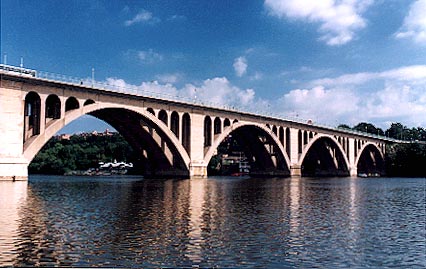
Perhaps the reason for this is that we built too many ugly bridges. The older bridges across the Potomac--Memorial Bridge, Key Bridge and Chain Bridge--are all quite beautiful. Don't take more word for it--the picture on top is of Key Bridge, the one just below it is Memorial Bridge.
Compare these with the 14th Street Bridge:
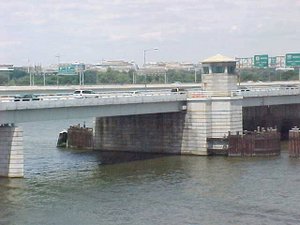
It is not hard to understand why people don't want more of these.
But bridges have made lives better for people--they have relieved congestion and, because they open up more urban land for development--reduced housing costs. While some urban planners sniffed that the post World War II suburbs of New Jersey and Long Island and Northern Virgina were banal, they also allowed the emerging middle class the ability to own houses at reasonable cost. These places would not exist in the absence of bridges.
Monday, October 09, 2006
In the Department of Self-Promotion
I am quoted in Robert J. Samuelson's newsweek column.
http://www.msnbc.msn.com/id/15173465/site/newsweek/page/2/
http://www.msnbc.msn.com/id/15173465/site/newsweek/page/2/
Thursday, October 05, 2006
Wednesday, October 04, 2006
Case-Shiller, Ofheo, etc.
This is a really wonky post, but after talking with a reporter today about house price indices, I couldn't help myself. The most commonly cited "constant quality" house price indices come from Case and Shiller, and from the Office of Federal Housing Enterprise oversight. These indices attempt to follow the price of a particular house at a particular place over time. To explain how they work, I will lift from my book with Steve Malpezzi:
Case-Shiller actually does a better job of keeping quality constant than OFHEO, but OFHEO has more coverage (I think). I will explain why in another post.
Repeat Sales Price Indexes
Repeat sales indexes are estimated by analyzing data where all units have sold at least twice. Such data allow us to annualize the percentage growth in sales prices over time. These are time-series indexes in their pure form. They do not provide information on the value of individual house characteristics or on price levels. They have the advantage of being based on actual transaction prices, and in principle allow us to sidestep the problem of omitted variable bias. However, units that sell are not necessarily representative of all units. Sometimes it's difficult to tell whether a unit retains the same characteristics across time. For example, remodeling could change a house’s characteristics.
The best way to understand how repeat sales indexes work is to look at an example. Figure 2.15 shows a graph of 17 properties that sold twice in the Shorewood Hills neighborhood of Madison, Wisconsin, in the late 1980s and early 1990s. Each property is numbered from 1 to 17, and each property appears twice. The Y-axis is the logarithm of the selling price of the unit.
We can think of the repeat sales estimator as an attempt to measure the average slope of the lines in Figure 2.15, year by year. In a classic paper, Bailey, Muth, and Nourse (1963) illustrated how to compute this using regression methods and a larger sample.
One way to motivate the actual technique used to construct the repeat sales index is to start by reconsidering the hedonic model. Consider a simple semilog hedonic equation
ln P = Xb + b1D1 + b2D2 + b3D3 + b4D4
where P is the value or rent for the unit, and where the vector X includes all the relevant characters, including a constant term; and the time dummies Di represent periods that follow the initial base case period.
The vector X represents a list of housing and neighborhood characteristics that would enter a hedonic equation. The vector D is a series of dummy variables representing the time periods under consideration. These could be months, quarters, or years, depending upon the type of data at hand.
Consider a house, “A,” that sells in periods 2 and 4 (period 0 is the base year). In period 2, we calculate:
ln PA2 = Xb + b1D1 + b2D2 + b3D3 + b4D4
= Xb + b2D2
since D1, D3, and D4 = 0. And of course, by similar reasoning, in period 4:
ln PA4 = Xb+ b4D4
Then, by subtraction, we find:
ln PA4 - ln PA2 = Xb + b4D4 - Xb - b2D2
= b4D4 - b2D2
This is for a representative housing unit that sells twice. Given a sample of such units, we want, in effect, the “average” b4 and b2. (Recall that regression is, in effect, estimating a series of conditional means.) Clearly, by subtraction, the characteristics vector drops out, as do the dummy variables for periods in which no transaction takes place.
Case-Shiller actually does a better job of keeping quality constant than OFHEO, but OFHEO has more coverage (I think). I will explain why in another post.
Tuesday, September 26, 2006
Long-term interest rates again
This morning's Wall Street Journal reports that long-term interest rates are at their lowest levels in months, with the ten-year Treasury at 4.55 percent. They also note:
The MBA has been ahead of the curve in figuring out how the inverted yield curve would affect refinancing. This should help soften price declines in the housing market, particularly in markets away from the coasts.
Nevertheless, yesterday's news on prices and inventories out of NAR was ugly: prices are falling a bit, and inventories are at a high for the decade.
Recent data from the Mortgage Bankers Association suggests that some families have taken advantage of a decline in long-term mortgage rates to refinance their mortgages and lock in lower payments. The association's index of mortgage refinancing applications has risen 27% since mid-July, and now stands at its highest level since February.
The MBA has been ahead of the curve in figuring out how the inverted yield curve would affect refinancing. This should help soften price declines in the housing market, particularly in markets away from the coasts.
Nevertheless, yesterday's news on prices and inventories out of NAR was ugly: prices are falling a bit, and inventories are at a high for the decade.
Subscribe to:
Posts (Atom)


